Collection: Sarracenia rubra
After Sarracenia purpurea, Sarracenia rubra is the second most widespread species in the genus. It colonizes the wet savannas and seepage swamps of the hills of North and South Carolina, Florida, Alabama, Georgia, and Mississippi. It is also one of the most variable species: five subspecies are generally distinguished (rubra, alabamensis, gulfensis, jonesii, and wherryi), and botanists are still debating their exact classification.
The plant produces two types of leaves throughout the year. The smaller and often drooping spring pitchers give way in summer to upright, more robust pitchers that are distinctly more veined with red. In the alabamensis subspecies, this second growth can be spectacular in its abundance.
Its flowering is one of its assets: each growth point produces many small red-to-brown flowers with a sweet fragrance that is sometimes compared to rose, violet, or grape. The plants sometimes form two flower spikes per growth point, which is unusual in the genus.
In cultivation, Sarracenia rubra requires full sun to develop good color. Very bushy, it benefits from being divided regularly, ideally in early spring: an overcrowded rhizome lacks aeration, which promotes necrosis and disease. Crossed with other Sarracenia, it produces elegant, medium-sized, and often highly colorful hybrids, such as S. x farnhamii or S. x chelsonii, which you will find in our hybrid collections.
At TerreAcrocs, find our divisions of Sarracenia rubra for sale, cultivated by us since 2009 and shipped quickly.


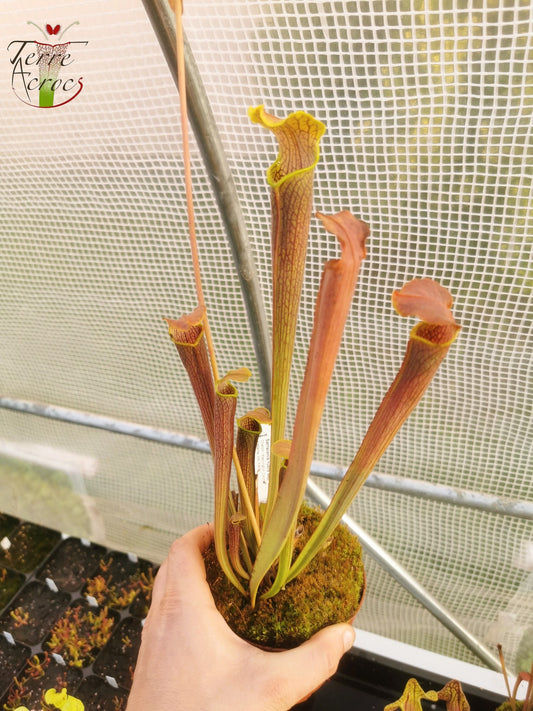 Bientôt disponibleSold out

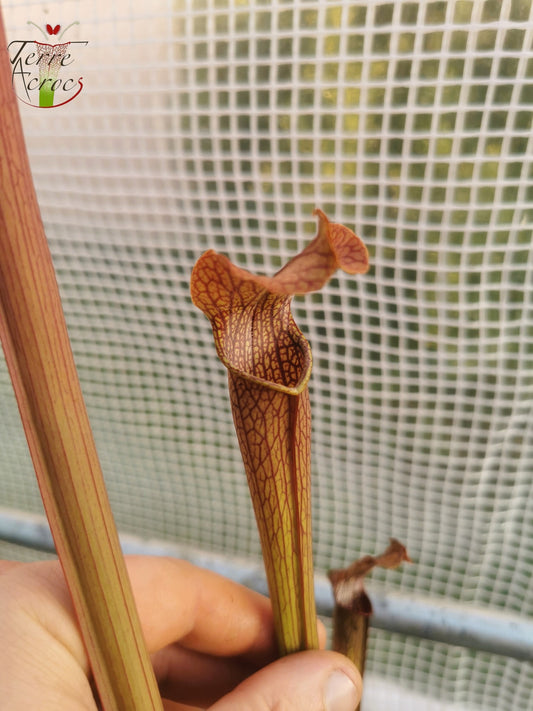 Bientôt disponibleSold out


